


A small group of people protested in front of the American Institute in Taiwan (AIT) yesterday, demanding that the truth about the death of a Taiwanese ship captain during a firefight between a US Navy ship and Somali pirates be made public and that the US compensate the captain’s family.
Wu Lai-yu (吳來于), captain of the Jih Chun Tsai No. 68, which was hijacked by pirates off the coast of Somalia in March last year and was used as a mothership, died on May 10 during a NATO anti-piracy mission carried out by the USS Stephen W. Groves.
Washington has yet to account for how the gunfight began and how Wu was killed, only saying that a team from the US warship found Wu and three pirates dead when it boarded the vessel. The US also confirmed that Wu was buried at sea.
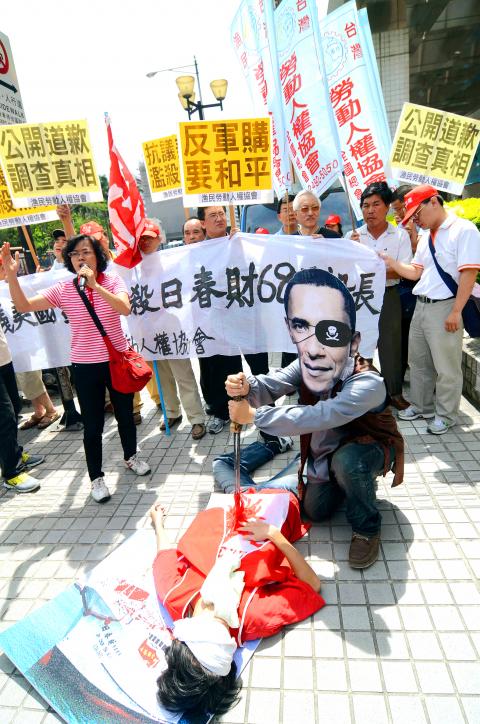
Photo: Wang Yi-sung, Taipei Times
Dozens of protesters representing the Human Rights Association for Taiwan Fishermen, the Labor Party and the Chung Hwa Baodiao Alliance protested to condemn the US for “killing the captain” and “destroying the corpse and obliterating the evidence.”
“The US hasn’t offered an apology, nor has it made any mention of compensation, which is why we are here today,” Labor Party -Secretary-General Tang Shu (唐曙) said.
Tang said Wu “was not killed by mistake,” but that it was a case of “an innocent civilian -slaughtered” by the US Navy, an act Tang said was “in violation of the principles for humanitarian rescue operations.”
“It’s outrageous that the US brazenly killed a hostage in international waters,” Tang said.
The protesters demanded the US publicly apologize to Wu’s family, provide compensation for losses — including Wu’s death and the sinking of the ship — and that the US allow Taiwanese officials to participate in an investigation into the accident.
A final request was that the US urge Japan to grant Taiwanese fishing rights in the disputed Diaoyutai Islands (釣魚台).
“It was because Japan prevented Taiwanese fishermen from operating in the waters surrounding the Diaoyutai Islands that Wu had sailed a long way to dangerous waters off eastern Africa to earn a living,” Human Rights Association for Taiwan Fishermen director Hsiao Wen-yi (蕭文義) said.
US support for Japan’s claim to the Diaoyutai Islands and the inclusion of the disputed waters in the Treaty of Mutual Cooperation and Security between the US and Japan has resulted in Japan’s arbitrary denial of Taiwanese fishermen’s right to operate there, Hsiao said.
The protest lasted about an hour, with demonstrators chanting slogans and delivering statements to AIT spokesperson Sheila Paskman, who came out to receive them.
Talking to representatives of the groups, Paskman said the AIT was aware that the matter was important and needed to be resolved.
Paskman said the AIT would contact the Ministry of Foreign Affairs as soon as it obtained new information about the incident from the US government.
Ecoterra International, an international NGO, said that on April 24, the USS Stephen W. Groves, operating as part of NATO’s counter-piracy mission, had fired upon and destroyed two unmanned pirate skiffs towed by the Jih Chun Tsai No. 68 while it was attached to the hijacked Italian bulker Rosalia’s Amato.
The military action by the US Navy has been described by Ecoterro as an “ill-conceived” and “botched” naval attack because it “endangered hostages in the first place” and was not followed by legal procedures to try the surviving pirates, whom NATO said in a statement have been returned to Somalia.
Also cast into doubt by Ecoterro was whether the US Navy was authorized to attack the pirate convoy.
“While trying to get information if the US naval attack against this pirated convoy was authorized by the vessel owner and/or the Italian government, we received first reports which clearly indicate that neither the Italian government nor the vessel owner had authorized any military action and as a matter of fact the navies were only requested to observe the vessel while it was commandeered to Somalia. Apparently the navies and especially NATO have been given firm instructions to stand down and to not wage any military action,” Ecoterro reported on May 20.
In an e-mail reply to the Taipei Times regarding the operation, AIT spokesperson Christopher Kavanagh said: “All at-sea counter-piracy engagements are designed to avoid casualties. We do not, however, discuss the details of specific counter-piracy operations.”
“Under international law, all states, including the United States, have a duty to cooperate in repressing piracy. Generally, a warship has the right under international law to board any vessel reasonably suspected of engaging in piracy,” Kavanagh said.
He said the US Department of Defense was undergoing a “factual review” of the circumstances surrounding Wu’s death.
The AIT provided some additional information about the Jih Chun Tsai No. 68 and Wu to the ministry over the weekend, he said.
“As we receive more details, we will share them with the Ministry of Foreign Affairs,” he said.
Bruce Linghu (令狐榮達), the director-general of the ministry’s Department of North American Affairs, confirmed to the Taipei Times that the AIT had provided more information to the ministry, but that it was not a final investigation report.

Japan has deployed long-range missiles in a southwestern region near China, the Japanese defense minister said yesterday, at a time when ties with Beijing are at their lowest in recent years. The missiles were installed in Kumamoto in the southern region of Kyushu, as Japan is attempting to shore up its military capacity as China steps up naval activity in the East China Sea. “Standoff defense capabilities enable us to counter the threat of enemy forces attempting to invade our country ... while ensuring the safety of our personnel,” Japanese Minister of Defense Shinjiro Koizumi said. “This is an extremely important initiative for

Chinese Nationalist Party (KMT) Chairwoman Cheng Li-wun (鄭麗文) today accepted an invitation from Chinese President Xi Jinping (習近平) to lead a delegation to China next month, saying she hopes to promote the peaceful development of cross-strait relations and bring stability to the Taiwan Strait. “I am grateful and happy to accept this invitation,” Cheng said in a statement from the KMT chairperson’s office. Cheng said she hopes both sides can work together to promote the peaceful development of cross-strait relations, enhance exchange and cooperation, bring stability to the Taiwan Strait and improve people’s livelihoods. At today's news conference, Cheng said any efforts to

MORE POPULAR: Taiwan Pass sales increased by 59 percent during the first quarter compared with the same period last year, the Tourism Administration said The Tourism Administration yesterday said that it has streamlined the Taiwan Pass, with two versions available for purchase beginning today. The tourism agency has made the pass available to international tourists since 2024, allowing them to access the high-speed rail, Taiwan Railway Corp services, four MRT systems and four Taiwan Tourist Shuttles. Previously, five types of Taiwan Pass were available, but some tourists have said that the offerings were too complicated. The agency said only two types of Taiwan Pass would be available, starting from a three-day pass with the high-speed rail and a three-day pass with Taiwan Railway Corp. The former costs NT$2,800

The nation’s fastest supercomputer, Nano 4 (晶創26), is scheduled to be launched in the third quarter, and would be used to train large language models in finance and national defense sectors, the National Center for High-Performance Computing (NCHC) said. The supercomputer, which would operate at about 86.05 petaflops, is being tested at a new cloud computing center in the Southern Taiwan Science Park in Tainan. The exterior of the server cabinet features chip circuitry patterns overlaid with a map of Taiwan, highlighting the nation’s central position in the semiconductor industry. The center also houses Taiwania 2, Taiwania 3, Forerunner 1 and


 RSS
RSS